
How to Choose the Right College for Your Career Goals

0

If you are reading this, chances are you—or your child—have just finished board exams or entrance tests. The adrenaline of the exams has faded, only to be replaced by a different kind of anxiety: “Where do I go next?”

In India, choosing a college feels less like a personal choice and more like a family event. Everyone from your neighbor to your distant uncle has an opinion on which engineering college is “best” or which commerce degree has “scope.”

But here is the truth I have learned after years of counseling students: The “best” college on paper might be the wrong college for you.

A college isn’t just a place where you get a degree. It is where you build your network, shape your personality, and set the trajectory for your first job. Pick the right one, and it acts as a launchpad. Pick one solely based on a shiny billboard ad, and you might spend four years regretting it.

This guide isn’t about rankings or generic advice. It is a practical, step-by-step framework to help you find a college that actually aligns with your career goals.

Step 1: The “Course vs. College” Dilemma

Before you shortlist names, we need to address the elephant in the room. Should you choose a mediocre course in a top-tier college, or a top-tier course in an average college?

I see students struggle with this every single year.

If you are absolutely certain about your career path—say, you want to be a Computer Science Engineer or a Psychologist—prioritize the course. Studying a subject you hate just to have a “brand name” on your CV is a recipe for burnout. You will likely end up with poor grades and zero motivation.

However, if you are undecided or pursuing a general stream (like a B.A. or B.Com), prioritize the college. A better college provides exposure, better peer groups, and stronger soft skills training, which matters more in generalist roles.

The Golden Rule: Never compromise on the course if it defines your technical skill set.

Step 2: Digging Truth Out of Placement Hype

In India, “Placements” is the magic word. Colleges know this. That is why every brochure screams “100% Placement Assistance” or “Highest Package: 40 LPA.”

As a student, you need to be a detective here. Do not look at the Highest Package. That 40 LPA offer usually went to one exceptional student who probably would have succeeded anywhere.

Look at the Median Salary. The median salary tells you what the “average” student gets. If a college claims a highest package of 20 LPA but a median of 3 LPA, that is a red flag. It shows a massive disparity in the quality of education or the batch profile.

Ask these specific questions:

  • Which companies visit for your specific department? (Not just the college overall).
  • What is the role offered? (Is it a core job or a BPO/Sales role disguised as a core job?)
  • What is the placement percentage? (Assistance does not mean a guarantee).

Step 3: Faculty and Pedagogy

You are going to college to learn, right? It’s surprising how often this gets overlooked.

A fancy building with a glass façade doesn’t teach you; professors do. You need mentors, not just lecturers who read off PowerPoint slides.

How to check this? Go to the college website and look at the faculty profile for your department.

  • Do they have PhDs?
  • Have they published research papers recently?
  • Do they have industry experience?

Professors with industry experience are invaluable because they teach you how the real world works, not just what the textbook says. If the faculty list looks empty or vague, consider it a warning sign.

Step 4: Infrastructure (The Stuff That Matters)

I am not talking about air-conditioned classrooms or a fancy cafeteria. While those are nice, they don’t impact your career.

Focus on “Functional Infrastructure”:

  • Laboratories: If you are a science or engineering student, are the labs equipped with modern machinery, or equipment from the 1990s?
  • Libraries: Is there access to digital journals and international publications?
  • Incubation Centers: If you have a startup idea, does the college have an entrepreneurship cell to support you?

I once visited a college that had a beautiful swimming pool but no working computers in the CS lab. Don’t fall for the resort-like vibe if the academic tools are missing.

Step 5: The Alumni Network Advantage

This is the secret weapon of top colleges.

Your older people are your gateway to the industry. A strong, active alumni network can help you get internships, referrals, and mentorship.

The LinkedIn Test: Go to LinkedIn and search for the college name. Look at the “Alumni” tab.

  • Where are they working?
  • Are they in leadership positions?
  • Are they working in the companies you dream of joining?

If you can’t find many alumni on professional networks, it suggests that either the college is too new, or the graduates aren’t making a significant mark in the corporate world yet.

Step 6: Location and Industry Exposure

In the digital age, we like to think location doesn’t matter. But in India, it still does.

Colleges located in or near industrial hubs (like Bangalore, Pune, Hyderabad, Gurgaon, or Mumbai) naturally have better industry connect. Guest lectures are easier to organize, internships are plentiful, and industry visits happen frequently.

If you choose a college in a remote town, you might get a peaceful environment, but you will have to work twice as hard to network and find internships. If your course relies heavily on practical exposure (like Media, Hotel Management, or Tech), try to be where the action is.

Step 7: Return on Investment (ROI)

Education is an investment, but it shouldn’t cripple your family’s finances.

Calculate the Total Cost of Education (Tuition + Hostel + Mess + Travel) for the entire duration of the course. Compare this against the Average Starting Salary.

If you are spending ₹20 Lakhs for a degree that typically yields a ₹3 Lakh starting salary, the math doesn’t work out. You will spend the first decade of your career just paying off the education loan.

However, don’t just look at money. If a slightly more expensive college offers a significantly better brand value and network that accelerates your career growth later, it might be worth the initial stretch.

Step 8: The “Vibe” Check

Finally, trust your gut.

If possible, visit the campus. Talk to current students—not the ones chosen by the administration to guide you, but random students in the canteen. Ask them:

  • “Are you happy here?”
  • “Is the administration supportive?”
  • “How is the crowd?”

You are going to spend 3 to 4 prime years of your youth here. If the environment feels toxic, overly restrictive, or uninspiring, it will affect your mental health and your grades.

Conclusion: It’s Your Journey

Choosing a college is a balancing act between your dreams, your marks, and your finances.

It is easy to get swayed by peer pressure or aggressive marketing. But remember, the college is just a vehicle; you are the driver. Even if you don’t get into your “Dream College,” you can still have a stellar career if you choose a “Right Fit” college that supports your growth.

Take a deep breath. Do your research. Talk to people. And make a choice that feels right for your future, not just one that looks good on a bumper sticker.

5. FAQs

Q1: Does the college ranking (NIRF) really matter? A: Yes and no. Rankings like NIRF give you a baseline for credibility, ensuring the college meets certain standards of infrastructure and teaching. However, a high overall ranking doesn’t always mean the specific department you want to join is the best. Use rankings as a filter, not the final decision maker.

Q2: Should I take a drop year if I don’t get a good college? A: Take a drop year only if you are confident you can significantly improve your score and if the gap year won’t mentally exhaust you. If the difference is between a Tier-2 and Tier-3 college, it might be better to join the Tier-2 college and work hard on your skills rather than losing a year.

Q3: How important is campus life for my career? A: Extremely important. Soft skills like leadership, teamwork, and communication are often developed outside the classroom—in clubs, fests, and student committees. Recruiters today look for well-rounded personalities, not just academic robots.

Q4: Private University vs. Government College – which is better? A: Government colleges usually offer better ROI due to low fees and established reputations (like DU, IITs, NITs). However, top-tier private universities in India have updated their curriculums faster and often have better modern infrastructure. If you can afford it, a top private university is often better than a lower-tier government college.

Q5: Can I change my career path after choosing a college? A: Absolutely. Your major doesn’t lock you in forever. Many engineers become writers, and many arts graduates move into management. Look for colleges that offer “minor” degrees or open electives, allowing you to study subjects outside your core stream.


Hanuman Dham Lucknow: Location, History, Darshan Timings & Complete Guide

0

The city of the Nawabs, Lucknow, is also noted for its spirituality since time immemorial. Whereas everyone knows about the famous Hanuman Setu and Aliganj Mandir, there is yet another divine pearl on the bank of Gomti River in—Hanuman Dham Lucknow (also known as Hanumant Dham). A temple renowned for its breath taking orara nd peacefull riverside atmosphere has turned into a must visit spot for devotees who are in search of calm evade from the city hustles.

What is Hanuman Dham Lucknow?

Hanuman Dham Lucknow is a wonderful temple complex of Lord Hanuman, located at the centre of the city near the Gomti River banks at Lucknow (Qaisar Bagh ). Compare to over crowded old temples, Hanuman Dham is noted for its spaciousness, park-like environment, intricate stone carvings and an innovative architectural feat—the presence of thousands of miniature Hanuman figures carved into its walls and pillars.

Hanuman Dham

It functions not only as a temple but also as a spiritual oasis where nature and devotion come together harmoniously. There are disciples who visit this place to have the “Shanti” of Bajrangbali that often sit in the garden for hours after Darshan.

History of Hanuman Dham Lucknow

The past of Hanuman Dham Lucknow is very interesting, as it combines an ancient belief with a new restoration history. Per local belief and reports from devotees who throng the temple on normal days the temple was almost 400 years old when it occupied the site. It used to be historically a place where sadhus and saints would perform tapasya (penance) along the holy Gomti river.

For the long time, it was a simple shrine which was visited by the local people of Qaisar Bagh and Hazratganj. Yet, since then, the temple has been undergoing major renovation (Nav-Nirman) stage to be what we see today, Hanumant Dham.

A Unique Architectural Marvel:

The history of it, is what sets it apart from other buildings with its modern craftsmanship. The local community states that the reconstructed temple structure has lakhs of Hanuman idols and motifs in the small parts of the structure carved on stones, arches and pillars. This visual representation explains that Lord Hanuman is omnipresent (sarvavyapi) in this dham.

As the above note clearly indicates, the structure is large but it is still a place of pure devotional. Devotees are asked to respect the sanctity of the old sanctum (Garbh Griha) just as they did before it retains its ancient energy.

Religious & Spiritual Significance

For a devotee (Bhakti Marg follower), Hanuman Dham temple Lucknow holds immense significance. Lord Hanuman is the Sankat Mochan—the dispeller of distress.

  • Peace of Mind: Unlike busier temples where darshan is often hurried, Hanuman Dham allows devotees to sit, meditate, and chant the name of Ram.

  • Riverside Divinity: Being on the banks of the Gomti, the temple carries the purifying energy of the river, making it an ideal spot for morning meditation (Dhyana).

  • Wish Fulfillment: Many locals believe that offering a simple prayer here with a pure heart on Tuesdays helps in overcoming personal and professional obstacles.

Hanuman Dham Lucknow Location & How to Reach

The temple is centrally located, making it very accessible for tourists and locals alike.

  • Address: Near Hotel Clarks Avadh, Qaisar Bagh (Kaiserbagh), on the banks of River Gomti, Lucknow, Uttar Pradesh.

  • Landmark: It is situated very close to the famous Hanuman Setu Mandir and the Chhatar Manzil.

How to Reach:

  • By Metro: The nearest Metro Station is K.D. Singh Babu Stadium. From there, you can take a battery-rickshaw or auto to the temple (approx. 10-15 mins).

  • By Road: You can easily get an auto-rickshaw or cab (Ola/Uber) from Charbagh or Hazratganj. Ask for “Hanumant Dham near Gomti” or “Near Clarks Avadh.”

  • By Train: It is approx. 5-6 km from Charbagh Railway Station.

Darshan Timings & Best Time to Visit

To avoid disappointment, it is essential to know the Hanuman Dham Lucknow darshan timings. The temple generally follows the standard timings of major Lucknow temples.

Day Morning Timings Evening Timings
Mon – Sun 6:00 AM – 12:00 PM 4:00 PM – 9:00 PM
Tuesdays 5:00 AM – 1:00 PM 3:00 PM – 10:00 PM
  • Best Time to Visit: The evening Aarti (around 7:00 PM – 7:30 PM) is the most magical time. The temple lights reflect on the Gomti waters, creating a divine aura.

  • Crowd Alert: Tuesdays and Saturdays see heavy footfall. For a quiet darshan, visit on a Wednesday or Thursday morning.

Hanuman Chalisa at Hanuman Dham (Devotional Section)

Reciting the Hanuman Chalisa at this dham is considered highly auspicious. Sitting in the open courtyard facing the idol helps devotees focus.

Why we recite it:

The Chalisa is a poetic composition by Tulsidas Ji that praises Lord Hanuman’s strength, intelligence, and devotion to Lord Ram. It is not just a prayer; it is a shield against fear.

Beginning Verses (Doha):

Shri Guru Charan Saroj Raj, Nij Manu Mukuru Sudhari.

Barnau Raghubar Bimal Jasu, Jo Dayaku Phala Chari.

(Translation: Cleansing the mirror of my mind with the dust from the Lotus feet of my Guru, I narrate the pure glory of Lord Ram, which bestows the four fruits of life: Dharma, Artha, Kama, and Moksha.)

Understanding the Essence:

We do not need to simply read the words; we must feel them. When you recite lines like “Sankat Kate Mite Sab Peera,” visualize your troubles melting away under Hanuman Ji’s protection. The Chalisa teaches us that through service (Seva) and devotion (Bhakti), even the most impossible tasks become possible.

Popular Hanuman Bhajans & Aarti Sung Here

During the evening Aarti, the atmosphere at Hanuman ji mandir Lucknow becomes electric with the sound of bells and chants.

  1. Aarti Kije Hanuman Lala Ki: The primary Aarti sung at the end of the puja.

  2. Hey Bajrangbali Hanuman: A popular bhajan often played on the temple speakers.

  3. Duniya Chale Na Shri Ram Ke Bina: Reminding us that just as Ram rules the world, Hanuman rules the heart of Ram.

Devotional Tip: You don’t need to know the lyrics perfectly. Just clapping your hands and chanting “Jai Siya Ram” during the Aarti is enough to connect with the divine.

Things to Do at Hanuman Dham Lucknow

Apart from the main Darshan, here is how you can spend your time:

  • Parikrama: Do a clockwise circumambulation of the main shrine.

  • Admire the Carvings: Spend time looking at the walls; try to spot the different forms of Hanuman Ji carved in the stone.

  • Sit by the Gomti: There are sitting areas near the riverfront side of the temple. It is very cooling in the summer evenings.

  • Meditation: Bring a small mat or handkerchief and sit in a quiet corner for 10 minutes of silent prayer.

Nearby Temples & Places to Visit

Since Hanuman Dham Lucknow is in a prime location, you can easily cover other famous spots nearby:

  1. Hanuman Setu Mandir: Just a short distance away. This is the famous “Neem Karoli Baba” temple.

  2. Begum Hazrat Mahal Park: A beautiful historical park for a family walk.

  3. Shaheed Smarak: A peaceful monument dedicated to the martyrs, located right next to the river.

  4. Bada Imambara: Approx. 3-4 km away, the most iconic monument of Lucknow.

Travel Tips for Devotees

  • Dress Code: Please dress modestly. Avoid shorts or sleeveless clothes as this is a functional place of worship.

  • Parking: Limited parking is available near the entrance. It is better to park slightly away if you are visiting on a Tuesday evening.

  • Photography: Photography of the main idol (Garbh Griha) is usually restricted to maintain sanctity. However, you can take photos of the beautiful temple exterior and gardens.

  • Prasad: You can buy Boondi or Besan Laddoo from the shops outside the temple complex.

FAQs (People Also Ask)

Q1: Hanuman Dham Lucknow kaha hai?

Ans: Hanuman Dham (Hanumant Dham) Qaisar Bagh area mein, Hotel Clarks Avadh ke paas, Gomti nadi ke kinare sthit hai.

Q2: Kya Hanuman Dham aur Hanuman Setu ek hi hain?

Ans: Nahi. Yeh dono alag mandir hain lekin paas-paas hain. Hanuman Setu Neem Karoli Baba dwara banwaya gaya mandir hai, jabki Hanuman Dham apne “Nav-Nirman” aur architecture ke liye jana jata hai.

Q3: Hanuman Dham Lucknow darshan timings kya hain?

Ans: Mandir subah 6:00 baje se raat 9:00 baje tak khula rehta hai (Dopehar mein 12-4 band reh sakta hai). Tuesday ko timing badh sakti hai.

Q4: Can we visit with family and kids?

Ans: Yes, absolutely. The temple has a park-like atmosphere which is very safe and comfortable for families and children.

Q5: Is parking available at the temple?

Ans: Yes, there is roadside parking and a designated area, but it gets very full on Tuesdays (Bada Mangal).

Conclusion

Hanuman Dham Lucknow is more than just a structure of stone; it is a testament to the city’s undying faith in Bajrangbali. Whether you are a local seeking a quiet corner to pray or a tourist exploring the spiritual side of Awadh, this temple offers a perfect blend of divinity, art, and nature. Next time you are near the Gomti river, take a moment to bow your head at Hanumant Dham and feel the grace of the son of the wind god.

Jai Bajrangbali!

राधा कृष्ण मंदिर: प्रेम, भक्ति और अध्यात्म का पवित्र संगम

0

जब हम किसी Radha Krishna Mandir में प्रवेश करते हैं, तो वहां का वातावरण हमें तुरंत बाहरी दुनिया के शोर-शराबे से दूर कर देता है। घंटियों की गूंज, चंदन की भीनी खुशबू और भक्तों का ‘राधे-राधे’ का उद्घोष मन को एक गहरी शांति प्रदान करता है।

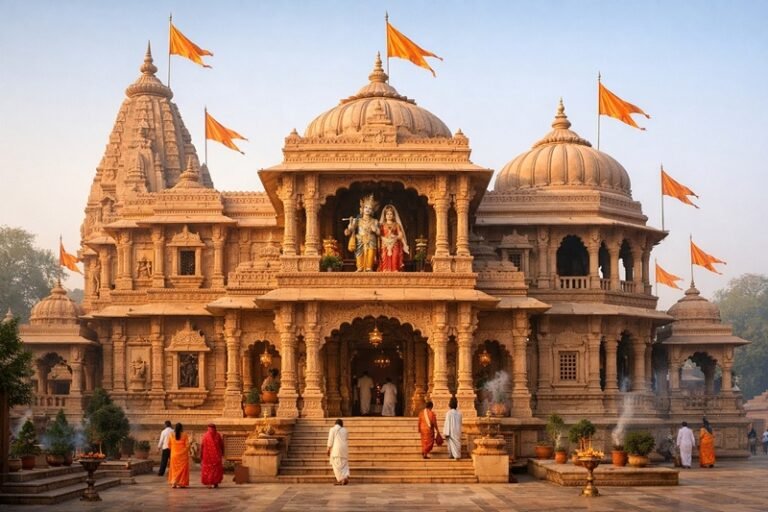
भारतीय संस्कृति में मंदिर केवल ईंट और पत्थर की इमारतें नहीं हैं; वे ऊर्जा के केंद्र हैं। विशेष रूप से, राधा और कृष्ण का मंदिर जीवात्मा (भक्त) और परमात्मा (ईश्वर) के मिलन का प्रतीक है। चाहे वह ऐतिहासिक वृंदावन हो या आपके शहर का कोई स्थानीय मंदिर, हर जगह श्री राधा और कृष्ण के विग्रह (मूर्ति) हमें निस्वार्थ प्रेम का पाठ पढ़ाते हैं।

इस लेख में, हम Radha Krishna Mandir के आध्यात्मिक महत्व, वृंदावन की महिमा, मंदिर की वास्तुकला और दर्शन के सही तरीकों पर विस्तार से चर्चा करेंगे।

Radha Krishna Mandir ka Adhyatmik Mahatva

राधा और कृष्ण साधारण देवी-देवता नहीं हैं। धर्मशास्त्रों के अनुसार, कृष्ण ‘शक्तिमान’ हैं और राधा उनकी ‘शक्ति’ हैं। जब आप किसी Shree Radha Krishna Mandir में जाते हैं, तो आप केवल दो मूर्तियों को नहीं देख रहे होते, बल्कि आप उस सर्वोच्च शक्ति को नमन कर रहे होते हैं जो प्रेम के माध्यम से संचालित होती है।

Radha Krishna

अक्सर लोग सोचते हैं कि राधा और कृष्ण का संबंध केवल प्रेम कथाओं तक सीमित है, लेकिन इसका आध्यात्मिक अर्थ बहुत गहरा है। राधा जी, भगवान कृष्ण की ‘ह्लादिनी शक्ति’ (आनंद प्रदान करने वाली शक्ति) हैं। भक्त मानते हैं कि कृष्ण को प्रसन्न करने का सबसे आसान रास्ता राधा रानी की कृपा से होकर जाता है।

यही कारण है कि मंदिरों में हमेशा ‘राधा’ का नाम ‘कृष्ण’ से पहले लिया जाता है। मंदिर का शांत वातावरण हमें यह सोचने पर मजबूर करता है कि जीवन में भौतिक वस्तुओं से ज्यादा महत्वपूर्ण मानसिक शांति और भक्ति है। यहाँ आकर हमें यह अनुभव होता है कि ईश्वर डरने का विषय नहीं, बल्कि प्रेम करने का विषय है।

Vrindavan Radha Krishna Mandir ka Mahatva

अगर धरती पर राधा-कृष्ण की भक्ति का कोई केंद्र है, तो वह वृंदावन है। Vrindavan Radha Krishna Mandir केवल भारत में ही नहीं, बल्कि पूरी दुनिया में प्रसिद्ध हैं। ब्रज की इस पावन भूमि के कण-कण में आज भी वह दिव्यता महसूस की जा सकती है।

वृंदावन में हजारों मंदिर हैं, लेकिन कुछ प्रमुख मंदिरों का अपना विशेष महत्व है:

  1. बांके बिहारी मंदिर: यहाँ ठाकुर जी (कृष्ण) का बाल रूप पूजा जाता है। यहाँ की विशेषता यह है कि विग्रह के सामने बार-बार पर्दा डाला जाता है, ताकि भक्त की नजर और ठाकुर जी का प्रेम इतना गहरा न हो जाए कि वह सुध-बुध खो बैठे।
  2. राधा वल्लभ मंदिर: यह मंदिर राधा रानी की प्रधानता के लिए जाना जाता है। यहाँ सेवा और पूजा का भाव अत्यंत दुर्लभ और प्रेममय है।
  3. प्रेम मंदिर: आधुनिक वास्तुकला का एक अद्भुत नमूना, जो रात की रोशनी में चमक उठता है। यह मंदिर शाश्वत प्रेम का प्रतीक है।

वृंदावन के मंदिरों में जाने का अनुभव सामान्य मंदिरों से अलग होता है। वहाँ की गलियों में, यमुना के घाट पर और मंदिरों के प्रांगण में जो ‘भाव’ (भावना) है, वह अद्वितीय है। वहाँ भक्त दर्शन करने नहीं, बल्कि अपने आराध्य से मिलने जाते हैं।

Shree aur Shri Radha Krishna Mandir ki Sanrachna

भारतीय वास्तु शास्त्र के अनुसार, Shri Radha Krishna Mandir का निर्माण एक विशेष विज्ञान पर आधारित होता है। मंदिर की संरचना मानव शरीर और ब्रह्मांड के संबंध को दर्शाती है।

  • गर्भगृह (Sanctum Sanctorum): यह मंदिर का मुख्य हिस्सा होता है जहाँ राधा और कृष्ण विराजमान होते हैं। यह स्थान जानबूझकर थोड़ा अंधेरा और शांत रखा जाता है ताकि भक्त का पूरा ध्यान केवल ईश्वर के तेज पर केंद्रित हो सके।
  • शिखर: मंदिर के ऊपर का शिखर मेरु पर्वत का प्रतीक माना जाता है। यह हमारी चेतना को ऊपर उठने की प्रेरणा देता है।
  • मंडप: यह वह स्थान है जहाँ भक्त एकत्रित होते हैं, कीर्तन करते हैं और कथा सुनते हैं।

चाहे आप किसी प्राचीन Shree Prasidh Krishna Mandir में जाएं या किसी नए मंदिर में, आप पाएंगे कि मूर्तियों का श्रृंगार बहुत विस्तृत होता है। उन्हें सुंदर वस्त्र, ताजे फूल और आभूषण पहनाए जाते हैं। यह कोई दिखावा नहीं है, बल्कि यह इस बात का प्रतीक है कि ईश्वर हमारे लिए सबसे प्रिय अतिथि और स्वामी हैं, जिनका स्वागत सर्वोत्तम तरीके से होना चाहिए।

Radha Krishna Mandir Near Me – Is Search ka Arth

आज के डिजिटल युग में, हम अक्सर Google पर Radha Krishna Mandir near me सर्च करते हैं। लेकिन क्या आपने कभी सोचा है कि इस सर्च के पीछे की असली वजह क्या है?

यह केवल एक लोकेशन खोजने की बात नहीं है। जब कोई व्यक्ति यह सर्च करता है, तो अक्सर वह जीवन की भागदौड़, तनाव या अकेलेपन से घिरा होता है और उसे शांति के एक आश्रय की तलाश होती है। आपके घर के पास का मंदिर केवल पूजा का स्थान नहीं है, बल्कि वह एक सामुदायिक केंद्र (Community Center) भी है।

स्थानीय मंदिर में जाने के कई फायदे हैं:

  • नियमितता: आप रोज सुबह या शाम वहां जा सकते हैं, जिससे दिनचर्या में सकारात्मकता आती है।
  • सत्संग: आपको ऐसे लोगों का साथ मिलता है जो सकारात्मक सोच रखते हैं।
  • मन की शांति: ऑफिस या घर के तनाव से 15 मिनट का ब्रेक लेकर मंदिर में बैठना, किसी भी थेरेपी से बेहतर हो सकता है।

Mandir Darshan ka Sahi Samay

यूं तो ईश्वर के द्वार भक्तों के लिए हमेशा खुले हैं, लेकिन Radha Krishna Mandir में दर्शन और ऊर्जा का लाभ उठाने के लिए कुछ विशेष समय सर्वोत्तम माने जाते हैं:

  1. मंगला आरती (प्रातः 4:00 – 5:00 बजे): यह दिन की पहली आरती होती है। इसे ‘ब्रह्म मुहूर्त’ भी कहा जाता है। इस समय मंदिर का वातावरण अत्यंत पवित्र और शांत होता है। ध्यान और प्रार्थना के लिए यह सबसे उत्तम समय है।
  2. शृंगार आरती (सुबह 7:00 – 8:00 बजे): इस समय भगवान को नए वस्त्र और आभूषण पहनाए जाते हैं। भक्त भगवान के सुंदर रूप का दर्शन करते हैं।
  3. संध्या आरती (गोधूलि बेला): शाम के समय जब दिन और रात का मिलन होता है, तब की जाने वाली आरती में कीर्तन और संगीत का विशेष महत्व होता है।

दोपहर के समय (आमतौर पर 12:00 से 4:00 बजे तक) अधिकांश मंदिरों के पट बंद रहते हैं। इसे भगवान का विश्राम समय माना जाता है। इसलिए, अपनी यात्रा की योजना बनाते समय मंदिर के समय-सारणी की जांच अवश्य कर लें।

Bhakton ke Liye Upyogi Salah

जब भी आप किसी Shri Radha Krishna Mandir में जाएं, तो मंदिर की मर्यादा और पवित्रता बनाए रखना आपकी जिम्मेदारी है। यहाँ कुछ सुझाव दिए गए हैं:

  • वस्त्र: भारतीय मंदिरों में सादे और शालीन वस्त्र पहनकर जाना उचित माना जाता है। यह सम्मान का प्रतीक है।
  • मोबाइल का प्रयोग: गर्भगृह के सामने या परिक्रमा करते समय मोबाइल पर बात करने या फोटो खींचने से बचें। यह न केवल दूसरों का ध्यान भटकाता है, बल्कि आपके अपने आध्यात्मिक अनुभव को भी कम करता है।
  • प्रसाद: यदि आप भोग लगाना चाहते हैं, तो तुलसी दल (तुलसी के पत्ते) के साथ मिठाई या फल ले जा सकते हैं। कृष्ण को तुलसी अत्यंत प्रिय है।
  • स्वच्छता: मंदिर परिसर को साफ रखें।
  • भाव: सबसे महत्वपूर्ण है आपका भाव। भगवान आपकी सामग्री के नहीं, आपके प्रेम के भूखे हैं।

Conclusion

अंत में, Lord Krishna Mandir जाना केवल एक धार्मिक अनुष्ठान नहीं है, बल्कि यह खुद को फिर से चार्ज करने की प्रक्रिया है। यह हमें याद दिलाता है कि जीवन का अंतिम लक्ष्य प्रेम और सेवा है। चाहे आप वृंदावन की गलियों में हों या अपने शहर के किसी छोटे से मंदिर में, जब आप राधा-कृष्ण के सामने सिर झुकाते हैं, तो आप अपनी चिंताओं को वहीं छोड़कर एक नई ऊर्जा के साथ वापस आते हैं। अगली बार जब आप मंदिर जाएं, तो केवल दर्शन न करें, बल्कि उस शांति को महसूस करें जो वहां सदियों से गूंज रही है।

Hanuman Chalisa in Kannada (ಹನುಮಾನ್ ಚಾಲೀಸಾ): The Complete Lyrics & Guide

0

Let’s be honest—life gets overwhelming. Whether it’s stress at work, health issues, or just a general feeling of anxiety, we all look for an anchor. For millions across India and the world, that anchor is the Hanuman Chalisa.

You aren’t just looking for lyrics; you are looking for strength.

Written by Goswami Tulsidas in the 16th century, these 40 verses (Chalisa) are more than just poetry. They are a “spiritual battery pack” for your soul. If you prefer reading and chanting in your mother tongue, the connection is even deeper.

Below, you will find the complete Hanuman Chalisa lyrics in Kannada. We’ve also included a guide on how to download this as a PDF and the incredible benefits of making this a daily habit.

Key Takeaways

  • Original Author: Goswami Tulsidas (Awadhi language).

  • Best Time to Chant: Morning (Brahma Muhurta) or Evening (Sandhya). Tuesdays and Saturdays are considered highly auspicious.

  • Core Benefit: Removes fear, instills courage, and provides mental clarity.

  • Format: Provided below in clear Kannada script (Kannada Lipi).

Hanuman Chalisa Lyrics in Kannada (ಹನುಮಾನ್ ಚಾಲೀಸಾ ಸಾಹಿತ್ಯ)

Here is the complete text. Scroll down, take a deep breath, and chant with devotion.

ದೋಹ

ಶ್ರೀ ಗುರು ಚರಣ ಸರೋಜ ರಜ, ನಿಜ ಮನ ಮುಕುರ ಸುಧಾರಿ | ಬರಣೌ ರಘುವರ ವಿಮಲ ಯಶ, ಜೋ ದಾಯಕ ಫಲ ಚಾರಿ || ಬುದ್ಧಿಹೀನ ತನು ಜಾನಿಕೇ, ಸುಮಿರೌ ಪವನ ಕುಮಾರ | ಬಲ ಬುದ್ಧಿ ವಿದ್ಯಾ ದೇಹ ಮೋಹಿ, ಹರಹು ಕಲೇಶ ವಿಕಾರ ||

ಚೌಪಾಯಿ

ಜಯ ಹನುಮಾನ ಜ್ಞಾನ ಗುಣ ಸಾಗರ | ಜಯ ಕಪೀಶ ತಿಹು ಲೋಕ ಉಜಾಗರ || 1 ||

ರಾಮ ದೂತ ಅತುಲಿತ ಬಲ ಧಾಮಾ | ಅಂಜನಿ ಪುತ್ರ ಪವನ ಸುತ ನಾಮಾ || 2 ||

ಮಹಾವೀರ ವಿಕ್ರಮ ಬಜರಂಗೀ | ಕುಮತಿ ನಿವಾರ ಸುಮತಿ ಕೇ ಸಂಗೀ || 3 ||

ಕಂಚನ ವರಣ ವಿರಾಜ ಸುಬೇಶಾ | ಕಾನನ ಕುಂಡಲ ಕುಂಚಿತ ಕೇಶಾ || 4 ||

ಹಾಥ ವಜ್ರ ಔ ಧ್ವಜಾ ವಿರಾಜೈ | ಕಾಂಧೇ ಮೂಂಜ ಜನೇವೂ ಸಾಜೈ || 5 ||

ಶಂಕರ ಸುವನ ಕೇಸರೀ ನಂದನ | ತೇಜ ಪ್ರತಾಪ ಮಹಾ ಜಗ ವಂದನ || 6 ||

ವಿದ್ಯಾವಾನ ಗುಣೀ ಅತಿ ಚಾತುರ | ರಾಮ ಕಾಜ ಕರಿವೇ ಕೋ ಆತುರ || 7 ||

ಪ್ರಭು ಚರಿತ್ರ ಸುನಿವೇ ಕೋ ರಸಿಯಾ | ರಾಮ ಲಖನ ಸೀತಾ ಮನ ಬಸಿಯಾ || 8 ||

ಸೂಕ್ಷ್ಮ ರೂಪ ಧರಿ ಸಿಯಹಿ ದಿಖಾವಾ | ವಿಕಟ ರೂಪ ಧರಿ ಲಂಕ ಜರಾವಾ || 9 ||

ಭೀಮ ರೂಪ ಧರಿ ಅಸುರ ಸಂಹಾರೇ | ರಾಮಚಂದ್ರ ಕೇ ಕಾಜ ಸಂವಾರೇ || 10 ||

ಲಾಯ ಸಂಜೀವನ ಲಖನ ಜಿಯಾಯೇ | ಶ್ರೀ ರಘುವೀರ ಹರಷಿ ಉರ ಲಾಯೇ || 11 ||

ರಘುಪತಿ ಕೀನ್ಹೀ ಬಹುತ ಬಡಾಯೀ | ತುಮ ಮಮ ಪ್ರಿಯ ಭರತಹಿ ಸಮ ಭಾಯೀ || 12 ||

ಸಹಸ ವದನ ತುಮ್ಹರೋ ಯಶ ಗಾವೈ | ಅಸ ಕಹಿ ಶ್ರೀಪತಿ ಕಂಠ ಲಗಾವೈ || 13 ||

ಸನಕಾದಿಕ ಬ್ರಹ್ಮಾದಿ ಮುನೀಶಾ | ನಾರದ ಶಾರದ ಸಹಿತ ಅಹೀಶಾ || 14 ||

ಯಮ ಕುಬೇರ ದಿಗಪಾಲ ಜಹಾಂ ತೇ | ಕವಿ ಕೋವಿದ ಕಹಿ ಸಕೇ ಕಹಾಂ ತೇ || 15 ||

ತುಮ ಉಪಕಾರ ಸುಗ್ರೀವಹಿ ಕೀನ್ಹಾ | ರಾಮ ಮಿಲಾಯ ರಾಜ ಪದ ದೀನ್ಹಾ || 16 ||

ತುಮ್ಹರೋ ಮಂತ್ರ ವಿಭೀಷಣ ಮಾನಾ | ಲಂಕೇಶ್ವರ ಭಯೇ ಸಬ ಜಗ ಜಾನಾ || 17 ||

ಯುಗ ಸಹಸ್ರ ಯೋಜನ ಪರ ಭಾನು | ಲೀಲ್ಯೋ ತಾಹಿ ಮಧುರ ಫಲ ಜಾನು || 18 ||

ಪ್ರಭು ಮುದ್ರಿಕಾ ಮೇಲಿ ಮುಖ ಮಾಹೀ | ಜಲಧಿ ಲಾಂಘಿ ಗಯೇ ಅಚರಜ ನಾಹೀ || 19 ||

ದುರ್ಗಮ ಕಾಜ ಜಗತ ಕೇ ಜೇತೇ | ಸುಗಮ ಅನುಗ್ರಹ ತುಮ್ಹರೇ ತೇತೇ || 20 ||

ರಾಮ ದುಆರೇ ತುಮ ರಖವಾಲೇ | ಹೋತ ನ ಆಜ್ಞಾ ಬಿನು ಪೈಸಾರೇ || 21 ||

ಸಬ ಸುಖ ಲಹೈ ತುಮ್ಹಾರೀ ಶರಣಾ | ತುಮ ರಕ್ಷಕ ಕಾಹೂ ಕೋ ಡರ ನಾ || 22 ||

ಆಪನ ತೇಜ ಸಂಹಾರೋ ಆಪೈ | ತೀನೋಂ ಲೋಕ ಹಾಂಕ ತೇ ಕಾಂಪೈ || 23 ||

ಭೂತ ಪಿಶಾಚ ನಿಕಟ ನಹಿ ಆವೈ | ಮಹಾವೀರ ಜಬ ನಾಮ ಸುನಾವೈ || 24 ||

ನಾಸೈ ರೋಗ ಹರೈ ಸಬ ಪೀರಾ | ಜಪತ ನಿರಂತರ ಹನುಮತ ವೀರಾ || 25 ||

ಸಂಕಟ ಸೇ ಹನುಮಾನ ಮುಡಾವೈ | ಮನ ಕ್ರಮ ವಚನ ಧ್ಯಾನ ಜೋ ಲಾವೈ || 26 ||

ಸಬ ಪರ ರಾಮ ತಪಸ್ವೀ ರಾಜಾ | ತಿನ ಕೇ ಕಾಜ ಸಕಲ ತುಮ ಸಾಜಾ || 27 ||

ಔರ ಮನೋರಥ ಜೋ ಕೋಯಿ ಲಾವೈ | ಸೋಯಿ ಅಮಿತ ಜೀವನ ಫಲ ಪಾವೈ || 28 ||

ಚಾರೋ ಯುಗ ಪ್ರತಾಪ ತುಮ್ಹಾರಾ | ಹೈ ಪರಸಿದ್ಧ ಜಗತ ಉಜಿಯಾರಾ || 29 ||

ಸಾಧು ಸಂತ ಕೇ ತುಮ ರಖವಾಲೇ | ಅಸುರ ನಿಕಂದನ ರಾಮ ದುಲಾರೇ || 30 ||

ಅಷ್ಟ ಸಿದ್ಧಿ ನವ ನಿಧಿ ಕೇ ದಾತಾ | ಅಸ ವರ ದೀನ್ಹ ಜಾನಕೀ ಮಾತಾ || 31 ||

ರಾಮ ರಸಾಯನ ತುಮ್ಹರೇ ಪಾಸಾ | ಸದಾ ರಹೋ ರಘುಪತಿ ಕೇ ದಾಸಾ || 32 ||

ತುಮ್ಹರೇ ಭಜನ ರಾಮ ಕೋ ಪಾವೈ | ಜನ್ಮ ಜನ್ಮ ಕೇ ದುಖ ಬಿಸರಾವೈ || 33 ||

ಅಂತ ಕಾಲ ರಘುವರ ಪುರ ಜಾಯೀ | ಜಹಾಂ ಜನ್ಮ ಹರಿ ಭಕ್ತ ಕಹಾಯೀ || 34 ||

ಔರ ದೇವತಾ ಚಿತ್ತ ನ ಧರಯೀ | ಹನುಮತ ಸೇಯಿ ಸರ್ವ ಸುಖ ಕರಯೀ || 35 ||

ಸಂಕಟ ಕಟೈ ಮಿಟೈ ಸಬ ಪೀರಾ | ಜೋ ಸುಮಿರೈ ಹನುಮತ ಬಲವೀರಾ || 36 ||

ಜೈ ಜೈ ಜೈ ಹನುಮಾನ ಗೋಸಾಯೀ | ಕೃಪಾ ಕರಹು ಗುರು ದೇವ ಕೀ ನಾಯೀ || 37 ||

ಜೋ ಶತ ಬಾರ ಪಾಠ ಕರ ಕೋಯೀ | ಛೂಟಹಿ ಬಂದಿ ಮಹಾ ಸುಖ ಹೋಯೀ || 38 ||

ಜೋ ಯಹ ಪಢೈ ಹನುಮಾನ ಚಾಲೀಸಾ | ಹೋಯ ಸಿದ್ಧಿ ಸಾಖೀ ಗೌರೀಸಾ || 39 ||

ತುಲಸೀದಾಸ ಸದಾ ಹರಿ ಚೇರಾ | ಕೀಜೈ ನಾಥ ಹೃದಯ ಮಹ ಡೇರಾ || 40 ||

ದೋಹ

ಪವನ ತನಯ ಸಂಕಟ ಹರಣ, ಮಂಗಲ ಮೂರತಿ ರೂಪ | ರಾಮ ಲಖನ ಸೀತಾ ಸಹಿತ, ಹೃದಯ ಬಸಹು ಸುರ ಭೂಪ ||

How to Hanuman Chalisa Lyrics in Kannada (PDF)

Click to download PDF

Looking to keep this on your phone for offline reading? You don’t need to visit sketchy websites.

The easiest way to get this as a PDF right now:

  1. On Mobile (Chrome/Safari): Click the “Share” button on your browser. Select “Print” and then choose “Save as PDF”.

  2. On Desktop: Press Ctrl + P (Windows) or Cmd + P (Mac). Change the destination printer to “Save as PDF”.

This ensures you have a clean, ad-free version of the lyrics saved directly to your device.

Why You Should Chant It Daily (The Real Benefits)

You might be chanting out of tradition, but did you know the psychological and spiritual benefits are immense?

  • Mental Strength: The verse “Bal buddhi vidya dehu mohi” specifically asks for strength, intelligence, and wisdom. It’s a daily affirmation for your brain.

  • Removing Fear: Verse 24, “Bhoot pishach nikat nahi aavai,” is widely believed to dispel negativity, nightmares, and irrational fears.

  • Focus & Discipline: Chanting the same verses daily creates a meditative loop, training your mind to focus better at work or studies.

FAQ: Common Questions About the Hanuman Chalisa

1. Can I read Hanuman Chalisa in Kannada if I don’t know Sanskrit? Absolutely. The power lies in the devotion (Bhakti), not just the language. Reading the Hanuman Chalisa lyrics in Kannada allows you to understand and pronounce the words correctly, which is better than struggling with a language you don’t read fluently.

2. What is the best time to chant the Hanuman Chalisa? Ideally, morning time after a bath is best for setting a positive tone for the day. However, many devotees chant it in the evening or before bed to remove the day’s stress and ensure good sleep.

3. How many times should I chant it? While chanting it once with full focus is enough, many people follow the tradition of chanting it 108 times during special occasions or 7 times a day during difficult periods in life.

4. Can women chant the Hanuman Chalisa? Yes, this is a common myth. There is no restriction in the scriptures preventing women from chanting the Chalisa. Devotion is universal.

Conclusion

Lord Hanuman represents the ultimate combination of strength (Shakti) and devotion (Bhakti). Whether you are facing a hurdle in your career, personal life, or health, taking 10 minutes to chant the Hanuman Chalisa in Kannada can be a game-changer for your mental peace.

10 Best Party Shirt Styles for Men: From Cocktail to Nightclub to Formal Events

0

Let’s be real for a second. We’ve all been there—standing in front of a full closet five minutes before the Uber arrives, staring at a sea of generic work button-downs and wrinkled t-shirts, thinking, “I have absolutely nothing to wear to this.”

The line between “underdressed” and “trying too hard” is razor-thin. Wear a stiff office shirt to a club, and you look like you just clocked out of a 9-to-5. Wear a loud Hawaiian print to a cocktail lounge, and you stick out like a sore thumb.

The secret isn’t owning a thousand shirts; it’s owning the right ones.

Whether you’re hitting a dive bar, a black-tie wedding after-party, or a rooftop mixer, your shirt does 90% of the talking. Here is the ultimate breakdown of the best party wear shirt for men styles to keep you looking sharp, no matter where the night takes you.

⚡ Key Takeaways: Quick Style Guide

  • The Golden Rule: Fit comes first. A $500 shirt that fits poorly looks worse than a $50 shirt that fits perfectly.

  • Fabric Matters: Satin and silk for night/clubs; linen and cotton for day/rooftops.

  • Tuck or Untuck? If the hem is flat (straight across), you can leave it out. If it has “tails” (curved hem), tuck it in for formal events, leave it out for casual bars.

1. The “Midnight” Satin Shirt

Best For: Nightclubs, Lounges, New Year’s Eve.

When the sun goes down, the matte fabrics should stay in the closet. You want something that catches the light. A satin or silk-blend shirt in a deep color—think midnight blue, charcoal, or emerald green—screams luxury.

It drapes better than cotton, moving with you on the dance floor rather than restricting you. Keep the rest of the outfit simple; let the sheen of the shirt be the main character.

2. The Cubano (Camp Collar) Print

Best For: Rooftop parties, Day drinking, Poolside mixers.

This is the king of summer vibes. The Camp Collar (or Cubano) is defined by its flat, open collar and boxy fit. It’s relaxed, breezy, and practically begs for a cocktail in hand.

Avoid the cheesy tourist prints. Instead, look for abstract geometric shapes, vertical stripes, or muted floral patterns. It’s a bold party wear shirt for men that says you’re here to have a good time without taking yourself too seriously.

3. The Classic Crisp White Oxford

Best For: Dinner dates, Company holiday parties.

You might think a white shirt is boring. You’d be wrong. A fresh, high-quality white Oxford shirt with the sleeves rolled up is arguably the most attractive thing a guy can wear. It works because it’s a blank canvas.

  • Style Tip: Pair it with dark denim and Chelsea boots for a rugged look, or tailored chinos and loafers for a sophisticated vibe. It’s the ultimate safety net—you will never look out of place.

4. The Modern Mandarin Collar

Best For: Art galleries, upscale dinners, fashion-forward events.

Want to stand out without wearing a loud color? Ditch the traditional collar. The Mandarin (or Band) collar removes the fold-over fabric around the neck, creating a clean, minimalist silhouette.

It’s sleek and modern. Because it lacks a collar, it naturally draws attention to your face. It’s a fantastic choice if you want to look dressed up but hate the feeling of a tie or a stiff collar digging into your neck.

5. The “Rockstar” Denim Shirt

Best For: Dive bars, Concerts, Casual house parties.

Denim isn’t just for jeans. A lightweight denim or chambray shirt is perfect for those “gritty” venues where a silk shirt would feel too precious. It handles spills well, doesn’t wrinkle easily, and looks better the more you beat it up.

Go for a “Double Denim” look (Canadian Tuxedo) only if the shades are different—like a light wash shirt with black jeans.

6. The Textured Knit Button-Down

Best For: Winter parties, Cozy dinner dates.

Texture is an underrated cheat code in men’s fashion. When everyone else is wearing flat cotton, a knit button-down (which feels like a polo but looks like a dress shirt) adds depth to your outfit.

It’s soft, stretchy, and incredibly comfortable. If you’re going to be sitting down for a long dinner, this is the shirt you want. It looks expensive but feels like you’re wearing pajamas.

7. The All-Black Monochrome

Best For: VIP sections, Techno clubs, High-end bars.

If in doubt, paint it black. An all-black outfit is slimming, sleek, and undeniably cool. However, the fit has to be razor-sharp. A baggy black shirt makes you look like a waiter; a fitted black shirt makes you look like you own the place.

Look for a party wear shirt for men with a slight stretch to keep that fitted silhouette intact through the night.

8. The Vertical Stripe

Best For: Beach weddings, Summer evenings.

Vertical stripes do two things: they add visual interest, and they make you look taller and leaner. It’s a classic visual trick. For a party vibe, opt for bolder, wider stripes rather than the thin pinstripes used in boardroom suits.

9. The Abstract “Art” Print

Best For: Creative industry events, Gallery openings.

Forget plaid and checks—those are for the office. When you’re partying, you want personality. “Micro-prints” or abstract art patterns are great conversation starters.

Keep the colors grounded (navy, burgundy, forest green) so the pattern doesn’t look like a costume. Pair this with solid-colored pants to keep the focus on the shirt.

10. The Linen Blend

Best For: Humid nights, Outdoor weddings.

There is nothing worse than sweating through your shirt five minutes after arriving at the party. Linen is breathable and airy. While 100% linen wrinkles if you look at it wrong, a linen-cotton blend gives you that breezy feel with a bit more structure.

Final Thoughts: Own the Room

Your clothes affect your energy. When you know your fit is on point, you walk taller, smile more, and have a better time. Whether you choose the rebel vibe of a denim shirt or the sophistication of a Mandarin collar, make sure you wear it with confidence.

Nvidia Stock Price Surge Explained: AI Chips & Data Center Demand

0

The recent movement in the nvidia stock price has drawn attention from both retail investors and institutional market participants. The scale and speed of the increase are not random. They reflect structural changes in how computing infrastructure is being built and how capital is being allocated within the technology sector.

Unlike short-term rallies driven by speculation, Nvidia’s price movement is closely linked to measurable demand for its products, particularly in artificial intelligence workloads and large-scale data centers. Earnings growth, capacity constraints, and long-term contracts all play a role in shaping market expectations.

This article explains why the stock has surged by examining the underlying business drivers, not price charts or hype. The focus is on what is changing inside the company’s core markets and why those changes matter for valuation, risk, and sustainability.

Core Business Factors Behind Nvidia’s Price Movement

The rise in Nvidia’s stock valuation is grounded in its position within high-performance computing rather than general semiconductor growth. Several internal and external factors are converging at the same time.

Key drivers include:

  • Concentrated demand from AI infrastructure builders

  • High margins on specialized chips

  • Long development cycles that reduce immediate competition

  • Strategic control over both hardware and software ecosystems

Each of these factors reinforces the others, creating a business environment that supports premium pricing and predictable revenue visibility.

AI Chip Demand Is Not a Short-Term Trend

Artificial intelligence workloads are fundamentally different from traditional computing tasks. Training and running large models requires massive parallel processing, high memory bandwidth, and optimized interconnects. Nvidia’s GPUs are designed specifically for these requirements.

What matters for the nvidia stock price is not AI popularity but infrastructure spending. Cloud providers, research institutions, and enterprise buyers are committing capital years in advance. These are long-duration investments, not experimental purchases.

Unlike consumer electronics cycles, AI infrastructure upgrades are capacity-driven. Once systems reach performance limits, expansion becomes unavoidable. This creates repeat demand rather than one-time sales spikes.

Data Center Expansion Is the Revenue Anchor

Data centers account for the largest share of Nvidia’s recent revenue growth. This segment behaves differently from gaming or consumer hardware.

Important characteristics include:

  • Multi-year procurement contracts

  • Lower sensitivity to short-term economic cycles

  • High switching costs due to software dependencies

  • Continuous performance upgrades rather than replacements

As global data usage increases, operators are optimizing for efficiency per watt and per rack. Nvidia’s hardware and system-level solutions align with this requirement, supporting sustained order flow.

Why Software Integration Matters

Hardware alone does not explain pricing power. Nvidia’s software stack, including drivers and development frameworks, locks customers into an ecosystem that reduces the incentive to switch suppliers.

This integration:

  • Shortens deployment timelines

  • Reduces operational risk for buyers

  • Increases total cost of migration to alternatives

For investors, this translates into more stable revenue expectations, which markets reward with higher valuations.

Earnings Growth and Margin Expansion

The stock price surge is also supported by earnings quality, not just revenue size. Nvidia’s recent results show expanding gross margins driven by premium AI products.

Higher margins signal:

  • Pricing power rather than volume discounting

  • Limited immediate competition at the same performance level

  • Efficient capital allocation

When earnings growth is accompanied by margin expansion, valuation multiples tend to hold even during broader market corrections. This has been a key stabilizing factor for the stock.

Supply Constraints Are Supporting Prices

Semiconductor manufacturing is capital-intensive and capacity is not easily scaled overnight. Nvidia’s most advanced chips rely on cutting-edge fabrication processes with limited global availability.

This constraint has two effects:

  • Customers place orders earlier and in larger quantities

  • Pricing pressure remains limited despite higher volumes

From a market perspective, constrained supply combined with rising demand supports both revenue visibility and profitability, strengthening investor confidence.

How the Market Is Valuing Nvidia Differently

Traditional semiconductor valuations focus on cyclical demand. Nvidia is increasingly being valued as infrastructure technology rather than a chip supplier.

This shift reflects:

  • Predictable enterprise demand

  • Software-like recurring revenue characteristics

  • Strategic importance to national and corporate AI initiatives

As long as this perception holds, the nvidia stock price will respond more to long-term growth assumptions than to quarterly fluctuations.

Common Misconceptions

  • “The stock is rising only because of hype”
    Actual revenue, margins, and order backlogs suggest otherwise.

  • “Competition will immediately compress margins”
    High-performance alternatives require years of ecosystem development.

  • “AI spending will slow quickly”
    Infrastructure investment cycles typically extend across multiple years.

Realistic Expectations

  • Volatility should be expected due to high valuation levels.

  • Growth rates may normalize, but absolute demand remains strong.

  • Long-term performance depends on continued execution, not headlines.

FAQs

Q1. Why has the nvidia stock price increased so rapidly?
The increase is driven by sustained demand for AI chips, strong data center revenue, and expanding profit margins, not short-term speculation.

Q2. Is Nvidia’s growth dependent only on artificial intelligence?
AI is the main driver, but data center infrastructure, enterprise computing, and software integration also contribute to long-term growth.

Q3. Can competitors reduce Nvidia’s market share quickly?
Unlikely in the short term due to software dependencies, performance gaps, and long customer adoption cycles.

Q4. Does a high valuation mean the stock is overvalued?
High valuation reflects future earnings expectations. Whether it is justified depends on Nvidia’s ability to maintain growth and margins.

CONCLUSION

The surge in the nvidia stock price is rooted in structural changes within computing infrastructure rather than temporary market enthusiasm. AI workloads, data center expansion, and ecosystem control have repositioned Nvidia within the technology landscape.

While valuation risks exist, the underlying business drivers are tangible and measurable. Investors evaluating the stock should focus less on price movements and more on demand durability, margin sustainability, and competitive positioning. The long-term outcome will depend on execution, not momentum.

What Is PAN?

0

PAN stands for Permanent Account Number. It is a unique 10-character alphanumeric identifier issued by the Income Tax Department to individuals and entities. The PAN card includes your PAN number, name, date of birth, photograph, signature, and a QR code. It functions both as a proof of identity and tax identification for many financial transactions in India.

Structure of PAN

The PAN’s structure is meaningful:

  • The first three characters are a sequence of letters (e.g., “AAA” to “ZZZ”).

  • The fourth character indicates the type of PAN holder (for example, “P” for individual, “C” for company, “H” for Hindu Undivided Family, etc.).

  • The fifth character is generally the first letter of the individual’s last name (or name, for non-individual entities).

  • The next four characters are numerical, running from 0001 to 9999.

  • The tenth character is an alphabetic check digit used to validate the PAN.

How to Apply for PAN

You can apply for a PAN card online or offline:

  • Online application: Use authorized portals (such as NSDL/Protean eGov or UTIITSL). Fill out Form 49A (for Indian citizens) or Form 49AA (for foreign applicants). Submit identity, address, and date-of-birth proof, pay the requisite fee, and complete verification. The physical PAN card is typically mailed within about 15 days.

  • Offline application: Download or collect a PAN application form from a PAN centre, fill it, attach required documents like proof of identity, address, date of birth, photographs, and submit to an authorized PAN centre.

Also, a newer version called PAN 2.0 is being introduced, which features an enhanced dynamic QR code for improved security and instant verification.

Uses and Importance of PAN

PAN has become indispensable in India’s financial and tax ecosystem. Key uses include:

  1. Tax filing: PAN must be quoted when filing income tax returns.

  2. Financial transactions: It is required for opening bank accounts, investing in mutual funds, buying or selling shares, applying for a credit/debit card, purchasing or selling vehicles or property, and other high-value transactions.

  3. KYC (Know Your Customer): PAN is often central to fulfilling KYC requirements in banking, insurance, and investment services.

  4. Tracking & transparency: PAN helps tax authorities monitor and link financial transactions, aiming to prevent tax evasion or underreporting.

  5. Compliance & reporting: Many financial institutions require PAN to be quoted when dealing with high cash deposits, large fund transfers, or other specified thresholds.

Because PAN is tied to many financial activities, ensuring it is operative and properly linked (for instance to Aadhaar) is critical. If PAN becomes “inoperative” (for example, through non-compliance with linking rules), it may hinder transactions or attract higher tax deductions.

Updating or Correcting PAN / Duplicate PAN

If your PAN needs correction (due to name change, address, etc.), or if your PAN card is lost, you can apply for an update or duplicate card:

  • Online through NSDL/Protean or UTIITSL portals.

  • Offline submission of the prescribed forms along with supporting documents.

  • The corrected or duplicate PAN is typically dispatched within a few weeks after verification.

Important Considerations

  • Linking PAN with Aadhaar: Regulations require PAN holders (who are eligible) to link their PAN with their Aadhaar number. Failure to do so may render the PAN inoperative and restrict certain financial activities.

  • Single PAN rule: An individual or entity must hold only one PAN. Possession of multiple PANs is illegal and may attract penalties.

  • Timely updates: If your personal details (name, address) change, you should apply for a correction so that all financial records remain consistent.

Conclusion

PAN is more than just a card—it is the backbone of India’s taxation and financial identification system. For Indian investors, PAN is vital not only for tax compliance but also as a gateway to almost all major financial operations—bank accounts, mutual funds, property transactions, and more. Applying for, keeping updated, and correctly linking your PAN are essential steps for a smooth financial journey in India.

Preschool Education in India: Building Foundations for a Brighter Future

0

Did you know that 85% of a child’s cumulative brain development occurs before the age of six?

Think about that for a second. By the time a child enters a formal first-grade classroom, the blueprint for their cognitive, emotional, and social future is largely already drawn.

In the India, we talk endlessly about “Pre-K” and “Head Start.” But across the ocean, preschool education in India is undergoing a massive, historic transformation. It’s a story of incredible scale, stark contrasts, and renewed hope. Whether you are a donor, a policy enthusiast, or just someone who cares about children’s rights, understanding this landscape is key to understanding the future of the world’s most populous nation.

Let’s dive into what’s happening on the ground and why it matters now more than ever.

A Tale of Two Systems: The Preschool Landscape

If you were to walk through India today, you’d see two very different worlds of early childhood education (ECE).

1. The Urban Private Sector

In bustling cities like Mumbai or Bangalore, you’ll find private preschools that rival the best in New York or London. They offer Montessori or Reggio Emilia curriculums, air-conditioned classrooms, and tablets for toddlers. While high-quality, these are often expensive and unregulated, accessible only to the wealthy few.

2. The Anganwadi System (The Backbone)

Step into a rural village, and you’ll find the Anganwadi. Established under the Integrated Child Development Services (ICDS) scheme, these are the world’s largest system of community-based childcare. There are over 1.3 million Anganwadis across India.

  • The Goal: They provide nutrition, health checkups, and preschool education to children from birth to age six.
  • The Reality: While they are a lifeline for millions, many struggle with lack of resources, overburdened staff (Anganwadi workers), and a focus that often leans more toward nutrition than education.

Key Takeaways

  • Brain Growth: Critical development happens before age 6.
  • The Gap: A massive divide exists between urban private schools and rural government centers.
  • The Fix: India’s NEP 2020 aims to standardize and improve quality across the board.
  • Your Role: Supporting NGOs is the fastest way to bridge the resource gap for marginalized kids.

The Game Changer: National Education Policy (NEP) 2020

For decades, the “10+2” system (similar to K-12) was the norm in India, often ignoring the preschool years entirely. The National Education Policy (NEP) 2020 flipped the script.

It introduced a 5+3+3+4 structure. The most radical change? The first “5”.

This “Foundational Stage” covers ages 3 to 8. It effectively brings three years of preschool (ages 3-6) into the formal education net for the first time.

  • No More Rote Learning: The policy mandates “play-based, inquiry-based, and activity-based” learning. No more forcing 3-year-olds to memorize textbooks!
  • Universal Access: The goal is to ensure every child has access to quality early childhood care and education (ECCE) by 2030.

This is a massive step forward. But policy is one thing; implementation is another.

The Challenges: Why Isn’t Every Child in School?

Despite the new policy and the vast Anganwadi network, millions of children still miss out. According to recent UDISE+ data, while enrollment is rising (80% of Class 1 students now have some preschool experience), the quality of that experience varies wildly.

Here are the hurdles we still need to clear:

1. The Quality Crunch

In many rural areas, “education” is often reduced to rote recitation. Without trained teachers who understand how toddlers learn, children miss out on critical cognitive stimulation.

2. Socio-Economic Barriers

Poverty is the great gatekeeper. When a family is struggling to put food on the table, education—especially for a 4-year-old—can seem like a luxury. Older siblings (often girls) are frequently kept home to care for younger ones, creating a cycle where neither gets an education.

3. The “Schoolification” of Preschool

Ironically, in the rush to “get ahead,” many low-cost private schools force formal academics (writing sentences, solving math problems) on toddlers too early. This isn’t education; it’s pressure. True preschool education is about curiosity, motor skills, and social interaction.

How We Can Bridge the Gap

This is where you come in.

Organizations like CRY America work tirelessly to bridge the gap between government promises and ground reality. We don’t just build schools; we build ecosystems.

  • Empowering Anganwadis: We work to upgrade infrastructure, ensuring centers have safe buildings, clean water, and bright, engaging learning materials.
  • Training Teachers: We support training programs that turn caregivers into educators, teaching them how to use play and local language to spark a child’s mind.
  • Community Awareness: We talk to parents. We help them understand that play is learning and that sending their daughter to preschool is the best investment they can make.

Conclusion: Be the Village

There is an old saying: “It takes a village to raise a child.” In a globalized world, that village includes you.

Preschool education in India isn’t just about teaching ABCs. It’s about breaking the cycle of poverty. A child who receives quality early education is more likely to stay in school, less likely to be exploited for child labor, and more likely to grow into an empowered, productive adult.

The blueprint is ready (NEP 2020). The infrastructure is vast (Anganwadis). What’s missing is the final push of resources and advocacy to make it work for the most vulnerable.

How the Largest Decision Sciences and Data Analytics Firms Drive Growth

0

The era of “trusting your gut” is effectively over. In today’s hyper-connected, volatile market, intuition alone is a liability. Companies are drowning in data but starving for insights. This paradox has given rise to a specialized breed of problem solvers: the largest decision sciences and data analytics firms. These organizations do not merely collect data; they apply a scientific lens to business problems, transforming vague information into concrete strategic roadmaps.

For the C-suite executive, understanding how to leverage these partners is no longer optional—it is the baseline for survival.

Key Takeaways

  • Problem Solving over Data Mining: The leading firms focus on the why and how, not just the what.
  • Interdisciplinary Approach: Success requires a blend of math, business, and technology.
  • Scalability: Only the largest decision sciences and data analytics firms offer the scale needed for global enterprise challenges.
  • The Mu Sigma Factor: Pioneers like https://www.mu-sigma.com/ have defined the industry standard by institutionalizing decision support.

The Evolution: From Reporting to Decision Sciences

Historically, analytics was about reporting. It answered the question, “What happened?” Today, the largest decision sciences and data analytics firms are answering a far more critical question: “What should we do next?”

This shift represents the transition from Descriptive Analytics to Prescriptive Analytics. While boutique agencies might handle specific coding tasks, the largest decision sciences and data analytics firms build entire ecosystems of decision-making. They integrate behavioral economics, applied mathematics, and business logic to simulate outcomes before capital is even deployed.

Defining the Landscape of Leaders

When you analyze the landscape, a clear distinction emerges between IT service providers and true decision science partners. The largest decision sciences and data analytics firms are characterized by their “Art of Problem Solving” mindset. They don’t just automate reports; they question the premise of the business challenge itself.

A prime example of this philosophy in action is https://www.mu-sigma.com/. As one of the most significant players in this space, they pioneered the idea that math and business must speak the same language. By treating decision sciences as a living organism within a corporation, they help Fortune 500 companies institutionalize data-driven thinking rather than treating it as a one-off project.

Why Scale Matters in Analytics

Why is there such a heavy emphasis on the largest decision sciences and data analytics firms? Can’t a small team handle the job?

In the realm of enterprise data, scale is quality. Large firms have access to:

  1. Talent density: Access to thousands of data scientists, varying from mathematicians to behavioral psychologists.
  2. Cross-Industry Knowledge: The largest decision sciences and data analytics firms can apply a supply chain lesson from the pharmaceutical industry to a logistics problem in retail.
  3. Technology Stacks: Access to proprietary platforms and AI accelerators that smaller firms simply cannot afford to build.

When a global retailer needs to optimize inventory across 50 countries in real-time, they inevitably turn to the largest decision sciences and data analytics firms because the infrastructure requirements are immense.

The Methodology of the Giants

What exactly happens inside these firms? The methodology used by the largest decision sciences and data analytics firms usually follows a cyclical path:

  1. Discovery: Defining the business problem clearly.
  2. Hypothesis Generation: Using decision sciences to predict potential drivers of the problem.
  3. Experimentation: Running algorithms and models against historical and real-time data.
  4. Operationalization: integrating the solution into the company’s daily workflow.

Firms like https://www.mu-sigma.com/ excel here because they focus heavily on the “Discovery” phase. They argue that a correctly defined problem is half-solved. This contrasts sharply with smaller tech vendors who might rush to code a solution for a problem they don’t fully understand. This rigorous intellectual discipline is the hallmark of the largest decision sciences and data analytics firms.

Selecting the Right Partner

If you are looking to hire one of the largest decision sciences and data analytics firms, look for a partner that challenges you. If a vendor simply says “yes” to every data request, they are a pair of hands, not a brain.

The most effective relationships are collaborative. The largest decision sciences and data analytics firms will push back on your assumptions. They will ask if you are tracking the right metrics and if your organizational structure allows for data-driven decisions. They act as a mirror, reflecting not just your data, but the health of your decision-making processes.

The Future is Algorithmic

As Artificial Intelligence and Machine Learning become commoditized, the “secret sauce” isn’t the code—it’s the application of that code to human problems. The largest decision sciences and data analytics firms are currently pivoting toward “Augmented Intelligence,” where AI assists humans rather than replacing them.

Whether you are looking to streamline operations or predict the next big consumer trend, the path forward involves partnering with experts who understand the math behind the madness.

Conclusion

Data is abundant, but clarity is rare. The largest decision sciences and data analytics firms are the architects of this clarity. By bridging the gap between raw numbers and business strategy, they empower leaders to act with confidence. Whether it is through the innovative frameworks of https://www.mu-sigma.com/ or the sheer processing power of global analytics giants, the goal remains the same: better decisions, faster.

Resource Optimization Services: Scale Faster & Work Smarter

0

You’ve been there. It’s Monday morning, a massive new project just got signed, and the first question isn’t “How do we win?” It’s “Who on earth is going to do the work?”

In most organizations, this triggers a frantic scramble. Managers check outdated Excel sheets, HR starts drafting generic job descriptions, and Finance starts sweating over the unbudgeted headcount. This isn’t just a stressful way to run a business—it’s a massive drain on your bottom line.

If you’re still relying on manual tracking, you’re not planning; you’re reacting. Workforce planning software changes the game by turning your talent pool from a confusing puzzle into a strategic asset.

Key Takeaways

  • Stop Reactive Hiring: Predict exactly who you’ll need six months before the project hits.

  • Skills Over Job Titles: Map the actual capabilities of your team to ensure the best fit for every task.

  • Boost Retention: Prevent burnout by balancing workloads based on real-time data.

  • Maximize Every Rupee: Ensure your most expensive talent is working on your highest-value goals.

The 2025 Reality: Why “Managing” Isn’t Enough

The days of simply having enough “bodies in seats” are over. In a market that moves at the speed of AI, your ability to scale depends on agility. Strategic workforce planning used to be a once-a-year board meeting event. Today, it has to happen every single day.

Standard HR tools tell you who works for you. Modern workforce planning software tells you what they can do, how they are feeling, and where they should go next.

Strategic vs. Operational Planning: You Need Both

Most firms fail because they only focus on the short term (Operational). They fix today’s fire but ignore the forest fire coming next season.

Feature Operational Planning Strategic Software (ProFinda)
Time Horizon Weeks to 3 Months 6 Months to 5 Years
Primary Goal Shift scheduling & daily tasks Long-term growth & skill evolution
Data Focus Attendance & Availability Skills, Potential & Market Trends
Business Impact Keeps the lights on Drives 20%+ ROI & Scalability

The Power of “Skill Intelligence”

The biggest shift in 2025 is the move from job-based planning to skill-based planning. Your “Senior Project Manager” might also be an expert in data visualization or speak three languages—skills that are invisible in a traditional hierarchy.

ProFinda’s workforce planning software uses a proprietary skills ontology. It doesn’t just look for keywords; it understands the relationship between different abilities. This means when a gap appears, the software can suggest an internal candidate for upskilling rather than forcing you into a $20,000 external recruitment cycle.

How Workforce Planning Software Pays for Itself

If you’re talking to your CFO about investing in new tech, they want to see the numbers. The ROI of effective planning software isn’t just “soft” benefits—it’s hard cash.

  1. Reduced “Bench Time”: In professional services, every hour a consultant sits idle is lost revenue. Software identifies these gaps instantly and suggests internal projects or training.

  2. Lower Recruitment Costs: It’s 5x cheaper to reskill an existing employee than to hire a new one. Planning tools show you exactly who is ready for a move.

  3. Burnout Prevention: High-performers often get “rewarded” with more work until they quit. Data-driven balancing keeps your best people from walking out the door.

  4. Accurate Budgeting: No more “best guess” headcount requests. You have the data to prove exactly why you need three new hires in Q3.

Why ProFinda is the Choice for High-Growth Firms

There are plenty of tools that can make a pretty chart. But ProFinda is built for the complexity of the modern enterprise. It’s designed for firms that don’t just want to survive the year, but want to dominate their niche.

  • AI-Powered Matching: Instantly find the perfect team for any project based on skills, cost, and availability.

  • Scenario Modeling: Run “What-If” scenarios. What happens if we lose a major client? What if we expand into the Middle East? See the impact on your workforce instantly.

  • Seamless Integration: It’s not another silo. ProFinda plugs directly into your existing CRM, ERP, and HCM systems.

FAQ: What You Need to Know

Q: Is workforce planning software different from HRIS?

A: Yes. An HRIS (Human Resource Information System) is a database for records like payroll and basic info. Workforce planning software is a strategic tool used to forecast future needs, model scenarios, and optimize talent allocation.

Q: How long does it take to see results?

A: Most firms see significant improvements in utilization rates within the first 3-6 months. The data becomes more powerful the longer you use it, as the AI learns your team’s patterns.

Q: Can this software help with Diversity and Inclusion (D&I)?

A: Absolutely. By focusing on skills and data rather than “gut feelings” or personal networks, software helps eliminate unconscious bias in project staffing and promotions.

It’s Time to Stop Running Blind

Your people are your most expensive asset—and your most valuable one. Continuing to manage them with tools designed for the 1990s is a recipe for stagnation.

In 2025, the competitive edge goes to the leaders who can see around corners. It goes to the teams that know exactly what they are capable of and where they are going.